The first Ten Amendments of the Constitution are known as The Bill of Rights. Click here to learn more.
The difference between school and life? In school, you're taught a lesson and then given a test. In life, you're given a test that teaches you a lesson.
Thursday, January 10, 2013
Thursday, December 13, 2012
Federalism: National vs. State Government
The U.S. Constitution establishes a government based on "federalism," or the sharing of power between the national, and state (and local) governments. Our power-sharing form of government is the opposite of "centralized" governments, such as those in England and France, under which national government maintains total power.
While each of the 50 states has its own constitution, all provisions of state constitutions must comply with the U.S. Constitution. For example, a state constitution cannot deny accused criminals the right to a trial by jury, as assured by the U.S. Constitution's 6th Amendment.
Under the U.S. Constitution, both the national and state governments are granted certain exclusive powers and share other powers.
Wednesday, December 12, 2012
"A Living Document" (The Amendment Process)
How could a 208 year-old document, written for a small agricultural nation of thirteen states endure through the tests of time to apply to today's immense, modern highly industrialized society? This is because of the flexibility with which the Constitution was imbued. The framers knew that they could not possibly plan for every circumstance or situation. As such, they provided various methods by which the Constitution and its laws could be modified as society grew and changed. That is why the United States Constitution is known as a "living constitution," one which can adapt and be flexible as necessary. There are three ways in which the Constitution is a "living" document: the formal amendment process; the informal amendment process; and custom, usage, and tradition. The formal amendment process is how amendments are added to the Constitution. Article V details the two methods to propose an amendment and the two methods to ratify an amendment. This part of the living constitution has been a useful tool by which Congress may enact an amendment. It keeps them honest in that the states must approve of any amendments by a three-fourths vote.
Tuesday, December 11, 2012
ChecPrevent Tyranny with a System of Checks & Balances!!!ks and Balances
![]() |
| System of Checks & Balances |
The national government is divided up into three branches: legislative, executive, and judicial. These three branches are not independent of one another because the Constitution set up a system of checks and balances to help ensure that no one branch became too powerful. Each branch has powers that it can use to check and balance the operations and power of the other two branches.
Monday, December 10, 2012
The Judicial Branch
![]() |
| The Supreme Court |
![]() |
The Roberts Court, 2010
Back row (left to right): Sonia Sotomayor, Stephen G. Breyer, Samuel A. Alito, and Elena Kagan. Front row (left to right): Clarence Thomas, Antonin Scalia, Chief Justice John G. Roberts, Anthony Kennedy, and Ruth Bader Ginsburg |
![]() |
| Federal Court Structure |
![]() |
| Federal Court System Diagram |
Saturday, December 8, 2012
Who Advises the President
![]() |
| President Obama's Cabinet |
The Cabinet includes the Vice President and the heads of 15 executive departments — the Secretaries of Agriculture, Commerce, Defense, Education, Energy, Health and Human Services, Homeland Security, Housing and Urban Development, Interior, Labor, State, Transportation, Treasury, and Veterans Affairs, as well as the Attorney General.
For more information click here
Thursday, December 6, 2012
Wednesday, December 5, 2012
Tuesday, December 4, 2012
Monday, December 3, 2012
The Preamble of the Constitution
"We the People of the United States, in Order to form a more perfect Union, establish Justice, insure domestic Tranquility, provide for the common defense, promote the general Welfare, and secure the Blessings of Liberty to ourselves and our Posterity, do ordain and establish this Constitution for the United States of America."
The Preamble to the United States Constitution is a brief introductory statement of the Constitution's fundamental purposes and guiding principles. It states in general terms, and courts have referred to it as reliable evidence of, the Founding Fathers' intentions regarding the Constitution's meaning and what they hoped the Constitution would achieve.The Preamble to the Constitution states the 6 goals of government...
1. form a more perfect union... make the best country possible
2. establish justice... create a fair system for our people
3. insure domestic tranquility... guarantee peace on our home land
4. provide for the common defense... provide protection for our citizens
5. promote the general welfare... work together for the common good
6. secure the blessing of liberty... protect our citizens rights & freedoms
5. promote the general welfare... work together for the common good
6. secure the blessing of liberty... protect our citizens rights & freedoms
The Social Contract
SOME EXTRAS FOR THE OVERACHIEVERS…
"Life, liberty, and the pursuit of happiness."
John Locke, a 17th century English Philosopher, insisted that men “have a mind to unite for the mutual Preservation of their Lives, Liberties and Estates, which I call by the general Name, ‘Property.’”
Adam Smith, an 18th century Scottish philosopher and economist whom some have called the father of free trade with his treatise The Wealth of Nations, penned the phrase “Life, Liberty and the pursuit of Property.”
Jefferson, according to historians, was a great follower of Adam Smith, and since he was well educated it’s very likely his inspiration for the phrase “Life, Liberty and the pursuit of Happiness” was derived from Locke and Smith.
The Leviathan
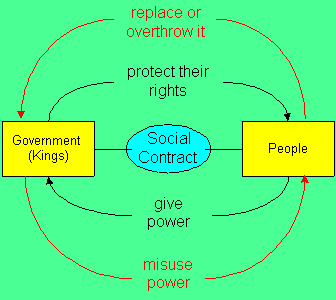
A “leviathan” is literally a sea monster mentioned in the Bible. It is also the title of a well known philosophy book written by Thomas Hobbs in 1651. The focus of the book is the structure of society and legitimate government. In the book, Hobbes argues for a "Social Contract," whereby by the people give up some of their absolute freedoms in exchange for governmental protection of human rights. Hobbs felt that “The State of Nature,” which is total chaos pitting man against man, could only be averted by strong central government.
Of The Social Contract, Or Principles of Political Right, is a philosophy book written in 1762 by Jean-Jacques Rousseau. In this book, Rousseau theorized about the best way in which to set up a political community in the face of the problems of commercial society which he had already identified in his “Discourse of Inequality.”
Friday, November 30, 2012
Thursday, November 29, 2012
The 3/5's Compromise
The Three-Fifths Compromise is found in Article 1, Section 2, Paragraph 3 of the United States Constitution:
Representatives and direct Taxes shall be apportioned among the several States which may be included within this Union, according to their respective Numbers, which shall be determined by adding to the whole Number of free Persons, including those bound to the Service for a Term of Years, and excluding Indians not taxed, three fifths of all other Persons.
Wikipedia explains:
The Three-Fifths Compromise was a compromise between Southern and Northern States reached during the Philadelphia Convention of 1787 in which three-fifths of the population of slaves would be counted for enumeration purposes regarding both the distribution of taxes and the appointment of the members of the United States House of Representatives ... Delegates opposed to slavery generally wished to count only the free inhabitants of each state. Delegates supportive of slavery, on the other hand, generally wanted to count slaves in their actual numbers. Since slaves could not vote, slaveholders would thus have the benefit of increased representation in the House and the Electoral College; taxation was only a secondary issue. The final compromise of counting "all other persons" as only three-fifths of their actual numbers reduced the power of the slave states relative to the original southern proposals, but increased it over the northern position.
Wednesday, November 28, 2012
The Great Compromise
The Great Compromise...
James Madison and William Paterson discuss how to fix the United States Government. Each have an idea but one favors small states and the other large states. Roger Sherman then rescued the two by coming up with the Great Compromise.
The Constitutional Convention in 15 Minutes...
Mr. Hughes explains the compromises which were brokered at the Constitutional Convention in 1787. Topics for discussion include the Connecticut Compromise (Great), the 3/5th's Compromise and the Anti-Feds demands for a Bill of Rights. Thank you Mr. Hughes!
Totally Off Topic...
The following video features a song written by John Prine entitled, The Great Compromise. Written in 1972, this protest song is a metaphor for Prine's disillusionment of his country during the Vietnam War. In this instance the songwriter is using the word "compromise" to mean a dishonorable or shameful concession.
Tuesday, November 27, 2012
Shay's Rebellion
Enjoy two short excerpts from a documentary on Shays' Rebellion. It has SUPERB animation! You can find the entire documentary on YouTube under the title, Shay's Rebellion 1787. It is posted in five pieces
Monday, November 26, 2012
The North Western Ordinance
The Northwest Ordinance was a law passed by Congress in 1787 to provide government for the Northwest Territory, located north of the Ohio River and west of Pennsylvania to the Mississippi River. Soon after its passage, settlers flocked westward and created new towns and farms throughout the territory.
This law divided the Northwest Territory into smaller territories, each governed by a territorial governor. As soon as a territory had 5,000 free adult males, it could elect its own legislature, or lawmaking body. When the population reached 60,000, a territory could apply to Congress to become a state.
Friday, November 16, 2012
Wednesday, November 14, 2012
Scholarly Paragraph
What is the political philosophy behind the American
Revolution?
1.
A sentence describing how the British
government tried to control the colonies.
2.
Three specific examples of British
control… “For example, ______, ________, and _______....
3.
Restate your first sentence using
different words
4.
Thesis: Something about the colonies or
the American Revolution and “self-government”
5.
Three individual sentences, each
containing a specific event or way in which the colonies fought for or
practiced self-government. Within
the sentence, provide the example and an explanation of that example.
Example:
“Individual colonies set up assemblies to write laws for their colonies.”
6.
Restate your thesis using different words
Wednesday, November 7, 2012
Study Guide Questions
Chapter 7
The American Revolution
1. List the strengths and weaknesses of the
Continental Army. (pg. 88)
2. List the strengths and weaknesses of the
British Army. (pg. 89)
3.
Did African Americans participate in the Revolutionary War and if so
what was there motivation. (pg.90)
4. What where the outcomes of the battles of
Trenton and Princeton and what did theses outcomes mean for America? (pg. 92)
5. How did Washington revise his strategy after
1776 and how was this strategy influenced by Native Americans? (pg. 93)
6. How did guerilla troops help the American
cause in the South? (pg. 96)
7. What territory did the Americans gain with
the Treaty of Paris? (pg.100)
8. Study the map
on page 99 and answer the following questions.
·
This map shows the
Battle of …
·
In which colony did this
battle take place?
·
Which 3 countries were
involved in these battles?
·
What was the outcome of
this battle?
9. Study the
excerpt of Thomas Paine’s The Crisis on
page 92. What is the message he
is trying to convey?
The Treaty of Paris
The Treaty of Paris, signed on September 3, 1783.
- It formally ended the American Revolutionary War between the Kingdom of Great Britain and the United States of America, which had rebelled against British rule.
- It acknowledged the Thirteen Colonies as free, sovereign and independent States.
- It granted the Thirteen Colonies all the territory east of the Mississippi River
Tuesday, November 6, 2012
Watching the Election Results?
This video may help you understand the Electoral College as you watch the results from the election come in.
Monday, November 5, 2012
Happy Guy Fawkes Day!
In recent years, the Fawkes' legacy has expanded. He provided the inspiration for aleen Moore's classic graphic novel, V for Vendetta, in which a crusader wearing a Guy Fawkes' mask embarks on a terrorist campaign against a totalitarian British dystopia. The novel has also been adapted in a major motion picture staring Nataile Portman. And today, the Occupy Wall Street protestors are recognizing the English holiday by wearing Guy Fawkes' masks at the various protests all across the country.
Saturday, November 3, 2012
The Crisis
The summer soldier and the sunshine patriot will, in this crisis, shrink from
the service of their country;
but he that stands it NOW,
deserves the love and thanks of man and woman.
Tyranny, like hell, is not easily conquered;
yet we have this consolation with us,
that the harder the conflict, the more glorious the triumph.
What we obtain too cheap, we esteem too lightly:
it is dearness only that gives every thing its value.
Heaven knows how to put a proper price upon its goods:
and it would be strange indeed if so celestial an article as FREEDOM should not be highly rated.
Victory at Trenton
Late on December 25, 1776, Washington's army crossed the ice-choked Delaware River in small boats. On the New Jersey shore, Washington gave his men the password for the long night march ahead: "Victory or Death."
The Hessians, sleeping heavily after their holiday feasting, were quite unaware of the approaching army. About sunrise they were surprised and most of them easily captured after a brief struggle.
Friday, November 2, 2012
A BIG Thank-You To My Room 5 Family
I just wanted to take a minute to thank all my students and their families.
The Dia De Los Muertos alter was especially beautiful this year.
Thank you so much for participating and getting so excited.
It really is a beautiful holiday and I enjoyed celebrating it with you all more than I can say.
Haylei Torres
Feliz Dia De Los Muertos
MUSIC!
An educational film made by a college student.
Subscribe to:
Posts (Atom)