Monday, January 23, 2012

Federalists vs. Republicans on the Issue of Freedom vs. Big Government

Thomas Jefferson
The Democratic-Republican Party...
  • believed in small, local government.
  • favored a narrow view on the meaning of the words in the Constitution (no wiggle room).
  • held that the federal government should not be able to do whatever it wanted nor should it be able to do things just because of convenience.
  • strongly felt that the federal government's powers should be limited to strictly what is laid out in the Constitution.
  • Jefferson, who led the party, worried that if the government could define it's own powers it would threaten the liberty of the people.

    Alexander Hamilton
    The Federalist Party...
    • believed in a strong federal government.
    • favored a broad view of the Constitution (lots of wiggle room).
    • held that the government should be able to do whatever is "necessary" to solve a problem.
    • Hamilton, the leader of the party, felt that all national problems should be handled by the federal government.


    Thursday, January 19, 2012

    New Jersey v. T.L.O. (1985)


     1. Does the Fourth Amendment protect students from searches by school officials?
     2. Under what circumstances, if any, can school officials search students or their belongings?

    Facts of the Case: 
    T.L.O. was a fourteen-year-old; she was accused of smoking in the girls' bathroom of her high school. A principal at the school questioned her and searched her purse, yielding a bag of marijuana and other drug paraphernalia.
    Question: 
    Did the search violate the Fourth and Fourteenth Amendments?
    Conclusion: 
    No. Citing the peculiarities associated with searches on school grounds, the Court abandoned its requirement that searches be conducted only when a "probable cause" exists that an individual has violated the law. The Court used a less strict standard of "reasonableness" to conclude that the search did not violate the Constitution. The presence of rolling papers in the purse gave rise to a reasonable suspicion in the principal's mind that T.L.O. may have been carrying drugs, thus, justifying a more thorough search of the purse.

    Wallace v. Jarffee (1985)

    1. Was the law authorizing a moment of silence for meditation or voluntary prayer an attempt to establish a religion?
    2. Is a child’s First Amendment right to freedom of religion violated if voluntary prayer is allowed in the school?

    Facts of the Case:
    An Alabama law authorized teachers to conduct regular religious prayer services and activities in school classrooms during the school day. Three of Jaffree's children attended public schools in Mobile.
    Question:
    Did Alabama law violate the First Amendment's Establishment Clause?
    Conclusion:
    Yes. The Court determined the constitutionality of Alabama's prayer and meditation statute by applying the secular purpose test, which asked if the state's actual purpose was to endorse or disapprove of religion. The Court held that Alabama's passage of the prayer and meditation statute was not only a deviation from the state's duty to maintain absolute neutrality toward religion, but was an affirmative endorsement of religion. As such, the statute clearly lacked any secular purpose as it sought to establish religion in public schools, thereby violating the First Amendment's Establishment Clause.

    Hazelwood School District v. Kuhlmeier (1988)

    1. Who is considered the publisher of a school newspaper, with the right to determine the content of the paper?
    2. Under what circumstances, if any, does the First Amendment allow school officials the right to censor school newspapers?

    Facts of the Case:
    The Spectrum, the school-sponsored newspaper of Hazelwood East High School, was written and edited by students. In May 1983, Robert E. Reynolds, the school principal, received the pages proofs for the May 13 issue. Reynolds found two of the articles in the issue to be inappropriate, and ordered that the pages on which the articles appeared be withheld from publication. Cathy Kuhlmeier and two other former Hazelwood East students brought the case to court.
    Question:
    Did the principal's deletion of the articles violate the students' rights under the First Amendment?
    Conclusion:
    No. In a 5-to-3 decision, the Court held that the First Amendment did not require schools to affirmatively promote particular types of student speech. The Court held that schools must be able to set high standards for student speech disseminated under their auspices, and that schools retained the right to refuse to sponsor speech that was "inconsistent with 'the shared values of a civilized social order.'" Educators did not offend the First Amendment by exercising editorial control over the content of student speech so long as their actions were "reasonably related to legitimate pedagogical concerns." The actions of principal Reynolds, the Court held, met this test.

    Tinker v. Des Moines (1969)

    Mary Beth and John Tinker
    1. Do students have a right to freedom of expression in school?
    2. Do school officials have the right to limit freedom of expression?


    Facts of the Case: 
    John Tinker, 15 years old, his sister Mary Beth Tinker, 13 years old, and Christopher Echardt, 16 years old, decided along with their parents to protest the Vietnam War by wearing black armbands to their Des Moines schools during the Christmas holiday season. Upon learning of their intentions, and fearing that the armbands would provoke disturbances, the principals of the Des Moines school district resolved that all students wearing armbands be asked to remove them or face suspension. When the Tinker siblings and Christopher wore their armbands to school, they were asked to remove them. When they refused, they were suspended until after New Year's Day.
    Question: 
    Does a prohibition against the wearing of armbands in public school, as a form of symbolic protest, violate the First Amendment's freedom of speech protections?
    Conclusion: 
    The wearing of armbands was "closely akin to 'pure speech'" and protected by the First Amendment. School environments imply limitations on free expression, but here the principals lacked justification for imposing any such limits.The principals had failed to show that the forbidden conduct would substantially interfere with appropriate school discipline.

    Wednesday, January 18, 2012

    The Bill of Rights


    The first Ten Amendments of the Constitution are known as The Bill of Rights.  Click here to learn more.

    Prevent Tyranny with a System of Checks & Balances!!!

    System of Checks & Balances
    The national government is divided up into three branches: legislative, executive, and judicial. These three branches are not independent of one another because the Constitution set up a system of checks and balances to help ensure that no one branch became too powerful. Each branch has powers that it can use to check and balance the operations and power of the other two branches.

    " A Living Document"

    How could a 208 year-old document, written for a small agricultural nation of thirteen states endure through the tests of time to apply to today's immense, modern highly industrialized society? This is because of the flexibility with which the Constitution was imbued. The framers knew that they could not possibly plan for every circumstance or situation. As such, they provided various methods by which the Constitution and its laws could be modified as society grew and changed. That is why the United States Constitution is known as a "living constitution," one which can adapt and be flexible as necessary. There are three ways in which the Constitution is a "living" document: the formal amendment process; the informal amendment process; and custom, usage, and tradition. The formal amendment process is how amendments are added to the Constitution. Article V details the two methods to propose an amendment and the two methods to ratify an amendment. This part of the living constitution has been a useful tool by which Congress may enact an amendment. It keeps them honest in that the states must approve of any amendments by a three-fourths vote.

    Tuesday, January 17, 2012

    Federalism: National vs. State Government


    The U.S. Constitution establishes a government based on "federalism," or the sharing of power between the national, and state (and local) governments. Our power-sharing form of government is the opposite of "centralized" governments, such as those in England and France, under which national government maintains total power.

    While each of the 50 states has its own constitution, all provisions of state constitutions must comply with the U.S. Constitution. For example, a state constitution cannot deny accused criminals the right to a trial by jury, as assured by the U.S. Constitution's 6th Amendment.

    Under the U.S. Constitution, both the national and state governments are granted certain exclusive powers and share other powers.

    Monday, January 16, 2012

    Martin Luther King Jr.


    1963 Newsreel Covering 'The March On Washington'


    Friday, January 13, 2012

    The Judicial Branch

    The Supreme Court

    The Roberts Court, 2010
    Back row (left to right): Sonia Sotomayor, Stephen G. Breyer, Samuel A. Alito, and Elena Kagan. Front row (left to right): Clarence Thomas, Antonin Scalia, Chief Justice John G. Roberts, Anthony Kennedy, and Ruth Bader Ginsburg
    Federal Court Structure
    Federal Court System Diagram

    Thursday, January 12, 2012

    Wednesday, January 11, 2012

    Who Advises the President?

    President Obama's Cabinet
    The tradition of the Cabinet dates back to the beginnings of the Presidency itself. Established in Article II, Section 2, of the Constitution, the Cabinet's role is to advise the President on any subject he may require relating to the duties of each member's respective office.

    The Cabinet includes the Vice President and the heads of 15 executive departments — the Secretaries of Agriculture, Commerce, Defense, Education, Energy, Health and Human Services, Homeland Security, Housing and Urban Development, Interior, Labor, State, Transportation, Treasury, and Veterans Affairs, as well as the Attorney General.

    For more information click here

    The Executive Branch

    The White House
    President Barack Obama & Vice President Joe Bidden
    The President's Cabinet

    Inspiration

    Monday, January 9, 2012

    Heads Up...

    The semester ends on January 27!!!

    • We will have our 2nd workbook check on Monday, January 16th.  You will be responsible for all the work book pages we have completed since the first workbook check.  Those pages are clearly listed here on the blog.
    • We will have one more benchmark sometime around Monday, January 23rd.
    • Finally, any and all late or missing assignments must be turned in NO LATER THAN WEDNESDAY, JANUARY 25th!!!
    • If your are curious about your current grade please see me before school, at nutrition, at lunch, or after school.  DO NOT ASK ME DURING CLASS TIME!!!

    Sunday, December 18, 2011

    StoryCorps


    StoryCorps is an American non-profit organization whose mission is to record, preserve, and share the stories of Americans from all backgrounds and beliefs. StoryCorps grew out of Sound Portraits Productions as a project founded in 2003 by radio producer David Isay.  Its headquarters are located in the Fort Greene neighborhood of Brooklyn, New York.

    StoryCorps is modeled—in spirit and in scope—after the efforts of the Works Progress Administration (WPA) of the 1930s, through which oral history interviews across the United States were recorded. Another inspiration for the organization was oral historian Studs Terkel, who cut the ribbon at the opening of StoryCorps’ first recording booth in Grand Central Terminal.  To date, StoryCorps has recorded more than 30,000 interviews among more than 60,000 Americans in all 50 states, Washington, D.C., and several American territories.


    To listen to some of the stories click HERE!

    Tuesday, December 13, 2011

    Writing Essentials

    When writing a summary you need...
    • A clear topic sentence (Setting, Subject, & Main Idea)
    • Details about the topic (Proof that you learned new material)
      • Supporting facts
      • Quotes
      • Examples
      • Content vocabulary
    • A conclusion statement that restates the topic and why it is important
    When writing in an academic setting always...
    • Use a formal style 
    • Be sure to be clear & coherent
    • Make sure your thoughts are organized and follow a logical order
    • Be neat and legible
    • Use transition words
    • Refer to yourself in the third person 


    Friday, December 9, 2011

    The Preamble to the Constitution

    "We the People of the United States, in Order to form a more perfect Union, establish Justice, insure domestic Tranquility, provide for the common defense, promote the general Welfare, and secure the Blessings of Liberty to ourselves and our Posterity, do ordain and establish this Constitution for the United States of America."
    The Preamble to the United States Constitution is a brief introductory statement of the Constitution's fundamental purposes and guiding principles. It states in general terms, and courts have referred to it as reliable evidence of, the Founding Fathers' intentions regarding the Constitution's meaning and what they hoped the Constitution would achieve.


    The Preamble to the Constitution states the 6 goals of government...
    1. form a more perfect union... make the best country possible
    2. establish justice... create a fair system for our people
    3. insure domestic tranquility... guarantee peace on our home land
    4. provide for the common defense... provide protection for our citizens
    5. promote the general welfare...  work together for the common good
    6. secure the blessing of liberty... protect our citizens rights & freedoms

    The Preamble to the Constitution
    The Preamble to the Constitution in Licenses Plates 

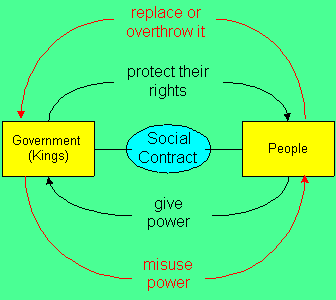
    The Social Contract


    SOME EXTRAS FOR THE OVERACHIEVERS…

    "Life, liberty, and the pursuit of happiness."
    John Locke, a 17th century English Philosopher, insisted that men “have a mind to unite for the mutual Preservation of their Lives, Liberties and Estates, which I call by the general Name, ‘Property.’”

    Adam Smith, an 18th century Scottish philosopher and economist whom some have called the father of free trade with his treatise The Wealth of Nations, penned the phrase “Life, Liberty and the pursuit of Property.”

    Jefferson, according to historians, was a great follower of Adam Smith, and since he was well educated it’s very likely his inspiration for the phrase “Life, Liberty and the pursuit of Happiness” was derived from Locke and Smith.


    The Leviathan
    A “leviathan” is literally a sea monster mentioned in the Bible.  It is also the title of a well known philosophy book written by Thomas Hobbs in 1651.  The focus of the book is the structure of society and legitimate government.  In the book, Hobbes argues for a "Social Contract," whereby by the people give up some of their absolute freedoms in exchange for governmental protection of human rights.  Hobbs felt that “The State of Nature,” which is total chaos pitting man against man, could only be averted by strong central government.

    Of The Social Contract, Or Principles of Political Right, is a philosophy book written in 1762 by Jean-Jacques Rousseau.  In this book, Rousseau theorized about the best way in which to set up a political community in the face of the problems of commercial society which he had already identified in his “Discourse of Inequality.”

    Monday, December 5, 2011

    The Electoral College


    The 3/5's Compromise


    The Three-Fifths Compromise is found in Article 1, Section 2, Paragraph 3 of the United States Constitution:

    Representatives and direct Taxes shall be apportioned among the several States which may be included within this Union, according to their respective Numbers, which shall be determined by adding to the whole Number of free Persons, including those bound to the Service for a Term of Years, and excluding Indians not taxed, three fifths of all other Persons.


    Wikipedia explains:
    The Three-Fifths Compromise was a compromise between Southern and Northern States reached during the Philadelphia Convention of 1787 in which three-fifths of the population of slaves would be counted for enumeration purposes regarding both the distribution of taxes and the appointment of the members of the United States House of Representatives ... Delegates opposed to slavery generally wished to count only the free inhabitants of each state. Delegates supportive of slavery, on the other hand, generally wanted to count slaves in their actual numbers. Since slaves could not vote, slaveholders would thus have the benefit of increased representation in the House and the Electoral College; taxation was only a secondary issue. The final compromise of counting "all other persons" as only three-fifths of their actual numbers reduced the power of the slave states relative to the original southern proposals, but increased it over the northern position.

    Friday, December 2, 2011

    The Great Compromise

    The Great Compromise...
    James Madison and William Paterson discuss how to fix the United States Government.  Each have an idea but one favors small states and the other large states.  Roger Sherman then rescued the two by coming up with the Great Compromise.


    The Constitutional Convention in 15 Minutes...
    Mr. Hughes explains the compromises which were brokered at the Constitutional Convention in 1787. Topics for discussion include the Connecticut Compromise (Great), the 3/5th's Compromise and the Anti-Feds demands for a Bill of Rights.  Thank you Mr. Hughes!


    Totally Off Topic...
    The following video features a song written by John Prine entitled, The Great Compromise.  Written in 1972, this protest song is a metaphor for Prine's disillusionment of his country during the Vietnam War.  In this instance the songwriter is using the word "compromise" to mean a dishonorable or shameful concession.